When developing the next iteration of an integration service while the old one
is still being maintained, how do you decide on an approach? This post shows how
envisioning possible futures helped us do it in a project for a large government
organization.1
Initial situation
The organization was operating a third-party application to manage customer
feedback. Initially, the application consisted of a rich client for internal staff, a
backend and a database. It was connected to several internal services via an
adapter component that had been developed and maintained in-house to decouple
the application from the services. The adapter component provided REST endpoints
used by the application to access customer and organizational data and also
contained a handful of batch processes that wrote to the database owned by the
application.
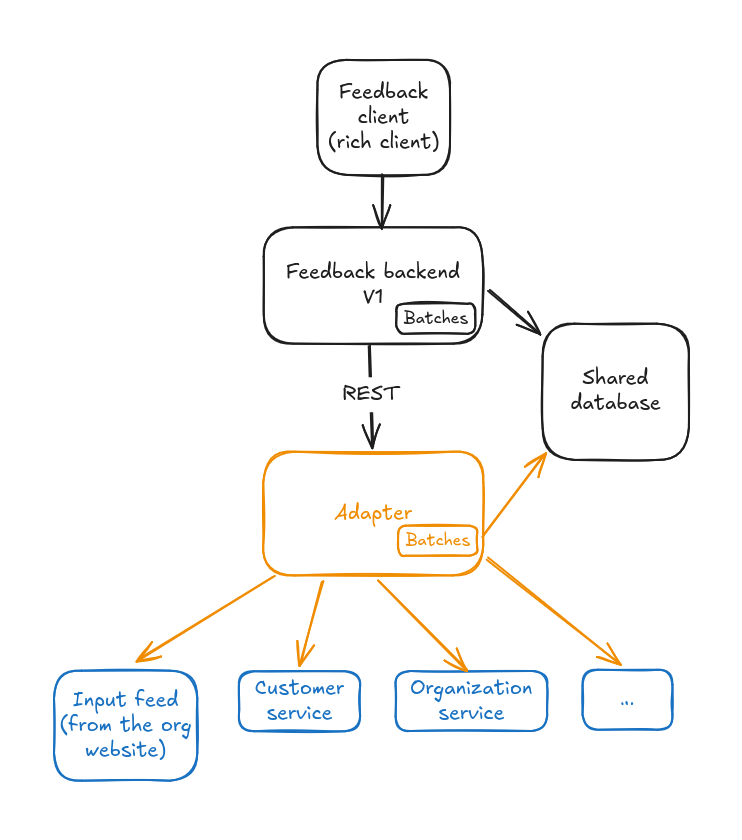
Initial architecture showing the third-party components (black), the adapter (orange) and the in-house services (blue)
When I say the adapter component had been developed and maintained in-house, I
don't mean the organization employed software developers to do the work.
I mean it had been developed by contractors and is operated and maintained as a
“managed service”, which really means a single guy, also a contractor, is doing
it.
The third-party application had not been upgraded in a long time, and the
version running at the customer site was nearing end of support. Therefore an
upgrade project had been initiated with the goal of upgrading the application to
a modern web-based version while preserving (and slightly improving) the
business functionality.
The project
The upgrade project was a major affair running for over a year. The part I was
involved in was updating the adapter component. This update had been scheduled
somewhere in the second half of the project.
Because this exceeded the capacity of the “managed service” (let's call him Fred),
the organization hired a team of contractors to do this.
I acted as the team's part-time lead developer.
One of the first things I discussed with the dev team and Fred was how best to
develop the new version while keeping the old version running in production,
given the constraints we were operating under.
Constraints
The first important constraint was time.
The contract ran for three months with no option to extend it.
And they meant that. When we started, the adapter was missing a feature the
users really wanted because the previous contractor who had been hired to work
on the component hadn't been able to complete it before running out of time.
The organization prioritized budget over business functionality.
This meant we would have to focus on the essential work early and do optional
parts later if we still had time.
Another constraint was that the release would not be done by us.
Over the past few years, I have become used to developing software in DevOps mode
where the developers are also responsible for bringing the software into
production, including monitoring operations, handling any issues during
migration, and cleaning up leftovers afterwards. In this project, however, the
actual switch to the new version of the application in production was scheduled
well past the end of our contract. This meant we would have to hand over
whatever we had produced to Fred at the end of the project, and he would be the
one dealing with the go-live and any issues during and after that.
Because Fred was busy with operations, maintenance tasks and minor extensions to
the old version, he was not part of the development team. This also
meant he was likely to make some changes to the old version in parallel with the
project that would have to be incorporated into the new version, too.
And the last important thing to know about this project is that most of the
changes implemented during the update were backward-incompatible by design.
The intent was not only to migrate 1:1, but also to make some architectural
improvements at the same time (replace database integration with REST APIs,
replace batch processes with a request/response pattern,
and redistribute responsibilities between the application and the
adapter2).
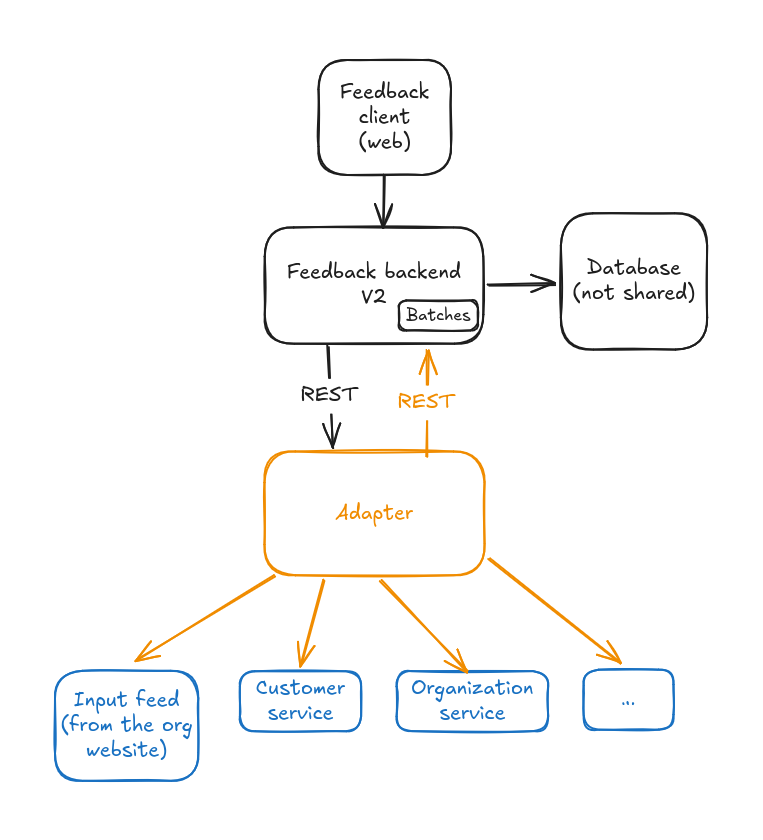
Target architecture showing the third-party components (black), the adapter (orange) and the in-house services (blue)
Three approaches
Given these constraints, we considered three basic approaches:
- Develop the new version in a new repository, deploy it to the test environment
separately. Later deploy it to production along with the new application version,
switch users over, discard the old version.
- Add new behavior and endpoints to the existing version (with path-based API
versioning and feature flags for background processes that write to the database
(in the old version) or send data to the application's REST endpoints (in the
new version)), deploy to test and production continuously using the
regular path to production. Later deploy the new client, toggle feature
flags and switch users over, then remove old behavior/endpoints.
- Develop on a branch in the existing repository, continuously merge
maintenance updates from the main branch, deploy to test and production
continuously alongside the old version3 (introducing a second path to
production, with feature flags for background processes4).
Later deploy the new client, toggle feature flags and switch users over, then
delete the old deployment.
On success, the branch for the new version becomes the main branch.
But how to decide which approach to take?
For this, we used our imagination to extrapolate what was likely to happen in
each case, considering both the happy path and possible failure modes.
Imagining these possible futures is a way of visualizing the interplay between
the given constraints, the chosen option and the people involved. Discussing
them within the team makes assumptions visible and enables us to address risks
by making them concrete.
Here is what we imagined.
The future with option 1
We develop and test the new adapter version in isolation and hand it over to
Fred after three months, along with architecture diagrams and detailed
instructions for the migration, then leave. This is the default expectation from
the customer. But let's see how this could play out!
Fred has been making changes to the old repository in parallel due to
maintenance and minor change requests, and we will not have been aware
of all of them, so there is some repair work to be done after we have left.
How will Fred do it? Probably in the time-honored way: by copying and pasting
between the repositories.
This is not trivial due to the structural changes we have made and thus likely
to introduce subtle bugs. If Fred is lucky, he will catch them before go-live;
if not, they will crop up some time later and cause extra work.
Two months after we leave, the new version of the application is ready,
and Fred wants to deploy the new adapter version to production. Some
of the instructions are not entirely clear (because they never are) and he has
forgotten some important points from the handover meeting (there is always
something you nod along to but forget afterwards). Also, because we developed
the solution in isolation, there will likely be some operational aspect we will have
overlooked. All in all, deployment to production will not be trivial, and Fred
will have to make some (hopefully minor) adjustments,
probably over the course of a few weeks, before everything is running smoothly.
Afterwards, he will have to remove the old deployment, archive the old
repository, and update all documentation that references the repository to point
to the new one. Such updates are likely to be
incomplete, so references to the old repository will remain and confuse future
developers (probably contractors without in-depth knowledge, too).
The future with option 2
We add new adapter behavior to the existing adapter using the same development
process as Fred (feature branches and pull requests to the main branch).
New and changed REST endpoints are exposed under “v2” URL paths.
Background processes that depend on the old or new version of the application
being available are implemented behind feature flags and tested in the test
environment in both variants (as soon as the new application version is
available there).
We see any changes Fred makes in his pull requests and can ensure they play
together well with the new behavior.
And Fred can see everything we are doing, too, so there is no real handover
necessary at the end.
Our changes are deployed to production along with Fred's changes, so when the
new version of the application is ready to go live after we have left, the
adapter is already ready for it in production. All that's left to do for Fred is
to toggle the feature flags to enable the new behavior.
The likelihood of something going wrong is drastically lower than with option 1,
but if it does, Fred is in a much better position to fix it because he has been
closer to our work the whole time, even though he was not officially part of the
development team.
After go-live, Fred will have to remove the old, now unused, endpoints and
behavior from the adapter (including some infrastructure dependencies like the
database connection), which means extra work for him, as well as a
(small) risk of introducing errors.
The future with option 3
We create a new branch from main in the existing repository and work on that.
The branch contains the complete new version of the adapter with anything
belonging only to the old version removed. We deploy the new version alongside
the old one to the test and production environments (pretty simple to do with a
Helm chart on a Kubernetes cluster). Background processes that depend on the new
version of the application being available are implemented behind feature flags,
which are switched on in the test environment, where the new application version
is already deployed, but off in production, where it is not.
We still see any changes Fred is making in his pull requests and merge them into
the new branch periodically, adjusting them as needed for the new version.
Fred can see everything we are doing due to the shared repository,
but he is likely not paying as much attention as in option 2, so we still
schedule handover sessions, but they are short and focused on the more subtle
issues Fred might have missed during the project.
This reduces the likelihood of later surprises when compared with option 1.
When the new version of the application is ready for go-live after we have left,
the new adapter version is already humming along in production, any deployment
issues having already been solved by us. The only thing left to do for Fred is
to toggle the feature flags to enable the new background processes.
Clean-up is limited to decommissioning the deployment of the old adapter, a
quick, low-risk change.
Deciding
After imagining these possible futures, we had to decide which option to pick.
Remember that these aren't predictions, just possibilities, and there were some
differences in opinion on how much effort would need to go into setting up a
separate deployment, and on how complex the cleanup in option 2 would be.
In the end, the team decided to pursue option 3, but it was a close decision.
Option 2 would have been a strong candidate too (option 1 was too error-prone in
our opinion). The decisive factor was that option 3 would front-load most of the
effort and leave Fred with as little work as possible.
You might have come to a different conclusion, but the point I want to make here
is not the decision itself. The point is that imagining these futures enabled us
to make the decision together, based on a common understanding of the dynamics
of the project.
Running with it
My part in the project is finished now. The three months are up, a working new
version of the adapter is running in production and we have had our handover
session. Deploying to production early actually did expose some operational
issues that Fred would otherwise have had to deal with.
The actual go-live is still in the future and knowing the customer, I don't
expect feedback on how it went anyway, so I can't say anything about that.
Given the same constraints, I would make the same choice again, but my next
project will probably have different ones so the best option might be different,
too.
At any rate, I will take with me the idea of exploring possible futures as a way
to come to a decision in the face of constraints, assumptions and uncertainty.
Image credits